
Pollinators and Their Functions

Pollination
We don’t always think of hummingbirds as pollinators, but they can be surprisingly important ones.
The obvious assumption is that hummingbirds are deliberately collecting pollen while feeding on nectar.
Apparently, that is not really the case.
Studies indicate that hummingbirds obtain less than about three percent of their protein from pollen.
Most of their protein comes from insects, which they pick from foliage or capture in flight much like a swallow.
Yet while visiting flowers for nectar, hummingbirds routinely brush against pollen-bearing structures and carry that pollen from flower to flower.
Their long bills and tongues make them particularly well suited to tubular flowers that many other pollinators cannot easily reach.
Next in line among the specialists are butterflies, with their long proboscises.
They are particularly well adapted to feeding from deep or tubular flowers, but they are hardly limited to them.
Butterflies also visit flatter flower heads such as asters and many other composite flowers.
Moths are important pollinators as well, particularly for flowers that open or become strongly fragrant at night.
Together, hummingbirds, butterflies, and moths occupy ecological niches that complement the work of bees.
And then there are the true champions of pollination: the bees.
Here we are not talking only about honey bees. Honey bees are perhaps the most familiar bee to most people, but they represent only one part of a remarkably diverse pollinator community.
Numerous species of native bees have their own preferences, behaviors, body shapes, and relationships with particular flowers.
Bumblebees are an excellent example. They routinely pollinate flowers that honey bees either visit poorly or avoid altogether. Rhododendrons are one example. Tomatoes are another.
Bumblebees can perform “buzz pollination,” vibrating the flower in a way that releases pollen from flowers specifically adapted to this type of pollinator.
Different plants support different pollinators, and this is where the subject becomes especially interesting for anyone who cares about sustainable agriculture, fields, pollinators, and the natural world.
A Mowed Field Is Nearly a Desert to Pollinators
A field of closely mowed grass can be almost as barren as a desert from a pollinator’s perspective.
That is not much of an exaggeration.
Most people mow for perfectly understandable reasons. They may believe that a manicured lawn is simply part of suburban life.
They may genuinely prefer the appearance of a closely cut lawn.
Some people even find mowing relaxing and satisfying. If that sounds surprising, it shouldn’t.
Many people enjoy the visible sense of order and accomplishment that comes from finishing a lawn.
Another powerful reason is social expectation. People worry that neighbors will judge them if the grass becomes too tall or if plants traditionally called “weeds” begin to appear.
That pressure is quite real, and it helps perpetuate a cycle of mowing, gasoline use, herbicide applications, equipment expense, time, and labor—often during the hottest part of the year.
There is, however, a practical way to break that cycle without making a property look neglected:
Be deliberate.
What does that mean?
Design the change rather than simply stopping the mower.
A planting of flowering plants bounded by landscape edging immediately looks intentional.
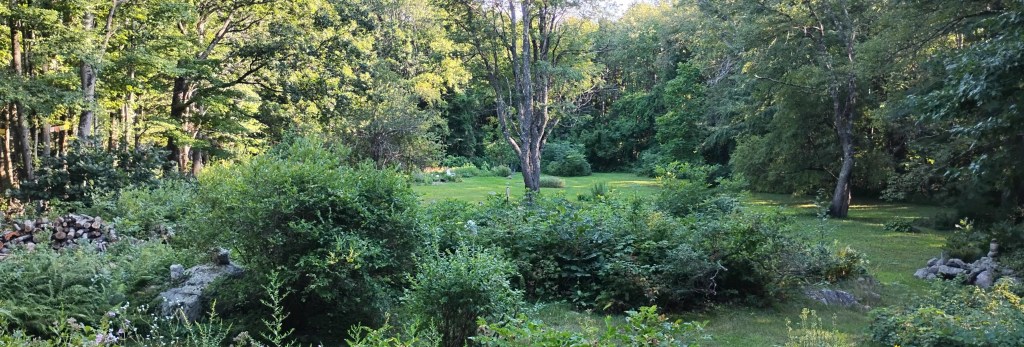
A section of lawn over-seeded with native or naturalized flowering plants can gradually become a meadow.
Curved boundaries, paths, islands, and mowed edges visually tell anyone looking at the property that what they are seeing is a landscape design rather than an abandoned lawn.
That distinction matters.
Simply allowing an entire front yard to grow without any visible structure can make neighbors uneasy.
A deliberately designed meadow surrounded by mowed grass, paths, or curved borders produces a completely different impression.
The remaining grass becomes part of the design.
Mow it in broad paths, flowing curves, or defined borders and the intent becomes obvious almost immediately.
Restoring Ecological Function
The reward is much greater than simply saving time behind a mower.
A flowering meadow begins restoring ecological functions that a closely mowed lawn largely eliminates. It can provide nectar and pollen over a much longer season, support native bees, butterflies, moths, hummingbirds, beetles, and other beneficial insects, improve soil biology, reduce erosion, increase organic matter, moderate soil temperature, and provide habitat for countless organisms that are part of a functioning ecosystem.
In that sense, converting part of a lawn into meadow is a small-scale form of restorative agriculture.
Instead of treating the land simply as a surface that must be controlled, we begin managing it as a living biological system.
And something else may happen.
When one property is transformed from uninterrupted lawn into an attractive, intentionally designed meadow, neighbors often begin experimenting themselves. One small flowering area appears next door. Then another. Gradually, what began as an individual landscape decision can become a neighborhood-scale network of pollinator habitat.
I have seen this happen firsthand.
Sustainable agriculture does not begin only on farms. It can begin in a backyard, along a driveway, beside a greenhouse, or in a small patch of former lawn.
The important first step is simply to make the change deliberately.
For those who want to take the idea further, ecological landscape design can also be combined with traditional approaches such as feng shui, using the placement of paths, plantings, open areas, and landscape features to create spaces that are both biologically productive and visually harmonious.
If you are interested in landscape design or feng shui-based planning, you can reach someone experienced in the art here: